Fuel tank
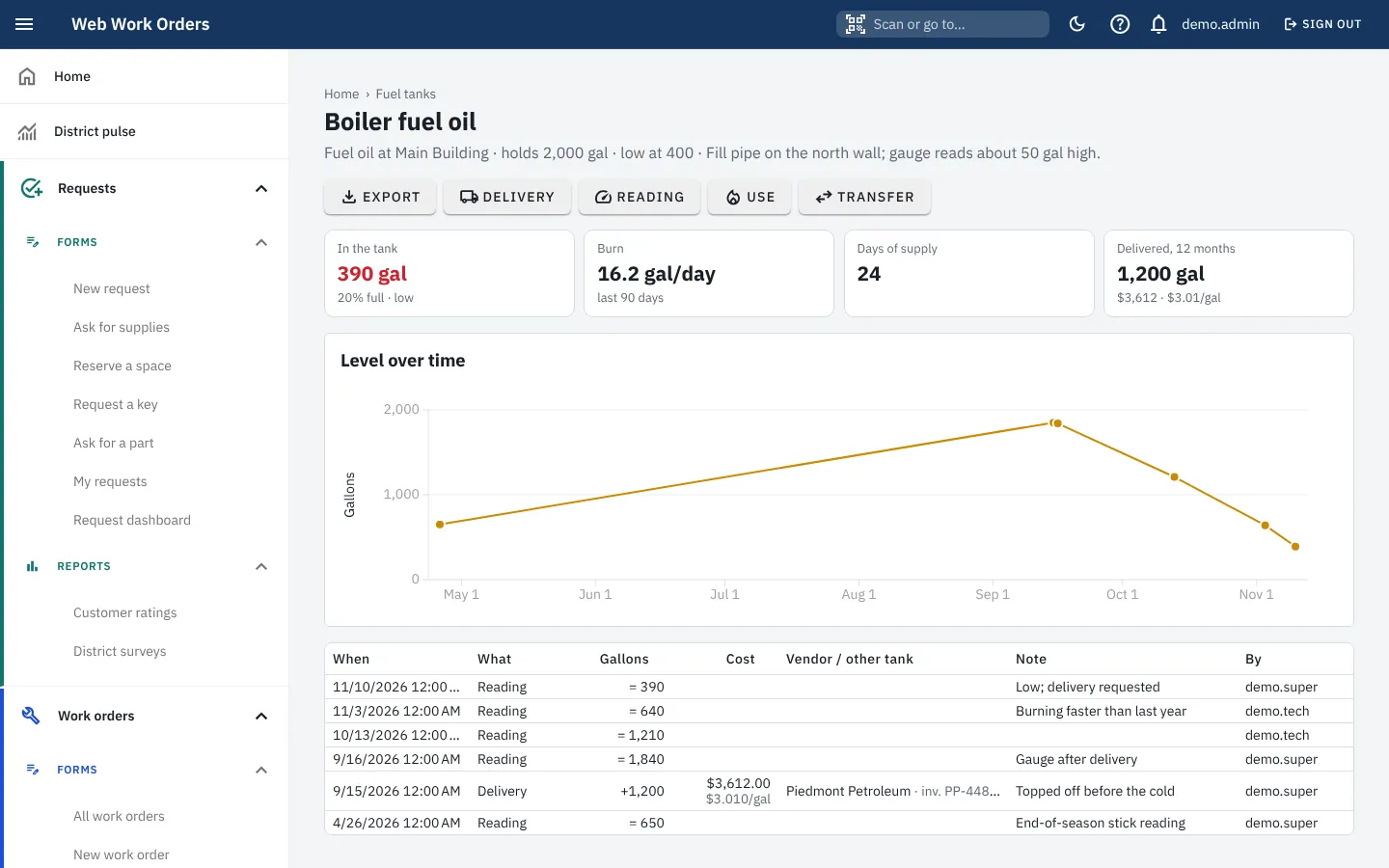
One tank: its level now, the burn rate and days of supply, the level over time, and every delivery, reading, use and transfer behind it.
How it helps
One tank: the level now, the burn per day, days of supply, the level over time, and every delivery with its cost and vendor, every gauge reading, use and transfer behind the numbers.
Who uses it
SupervisorsFinanceAdministrators
How to use it
- Record what happened: a delivery with its cost and vendor, a gauge reading (which resets the level to what you saw), fuel used or drawn, or a transfer to another tank. Nothing is deleted; a mistaken entry is corrected by a reading.
- The burn rate is what went in less how the level moved over the last 90 days; days of supply and days until low follow from it. A tank that reaches its low level sends a notice to supervisors, admins and finance.
Fields on this screen
- Tank
- What the district calls it: Boiler tank, Kitchen propane, Bus yard diesel. It shows on the list and in the low-level notice.
- Building
- The building or yard the tank serves; its fuel use rolls up to that school on the utilities pages.
- Fuel
- What is in it: fuel oil, propane, diesel, gasoline or kerosene. Deliveries and readings are in gallons whatever the fuel.
- Holds (gallons)
- What the tank holds when full. The level bar and the percent full are measured against it; a reading above it is refused.
- Low at (gallons)
- The level at which the tank counts as low and supervisors, admins and finance hear. Zero turns the notice off for this tank.
- Notes
- Anything the next person should know: the fill pipe location, the vendor's account number, a gauge that reads high.
- What happened
- A delivery (fuel came in), a gauge reading (what is in the tank now), use (fuel burned or drawn), or a transfer to or from another tank.
- When
- The day it happened. The level is worked out from the last reading forward through every entry after it, so the order of dates matters.
- Gallons
- Gallons delivered, used or moved. For a reading, the gallons in the tank from the gauge or stick.
- Cost
- What the delivery cost, so the price per gallon and the year's fuel spending can be seen. Leave blank when the bill is not in yet.
- Vendor
- Who delivered it. Type the name; it is kept with the delivery.
- Invoice
- The delivery ticket or invoice number, for matching the bill later.
- Other tank
- For a transfer: the tank the fuel went to or came from. Both tanks get the entry, one out and one in.
- Note
- A word on why: topped off before the cold snap, gauge read after the delivery, moved to cover the kitchen.
Where to find it
In the app at /utilities/tanks/…. Every screen has a ? in the header with help for that page.
Terms on this page
Related
Screenshots come from the Pine Valley Schools demo, a made-up district. Something unclear or out of date? Tell us and we'll fix it.